Hair Transplant Surgeon in Mumbai
Hair loss can affect more than your appearance. A receding hairline, thinning crown or noticeable bald patches may influence how you feel about your overall appearance and confidence. While hair loss can occur for several reasons, hair transplant surgery may be an option for people experiencing permanent hair loss who have sufficient healthy donor hair.
At The Plastic Surgeons, Dr. Vinay Jacob provides hair restoration consultations and surgical treatment planning based on each patient's hair loss pattern, scalp condition and expectations. If you are looking for a Hair Transplant Surgeon in Mumbai, understanding the available techniques, suitability, recovery and expected results is an important first step.
A personalised consultation helps determine whether hair transplantation is appropriate and which approach may be suitable for your needs.


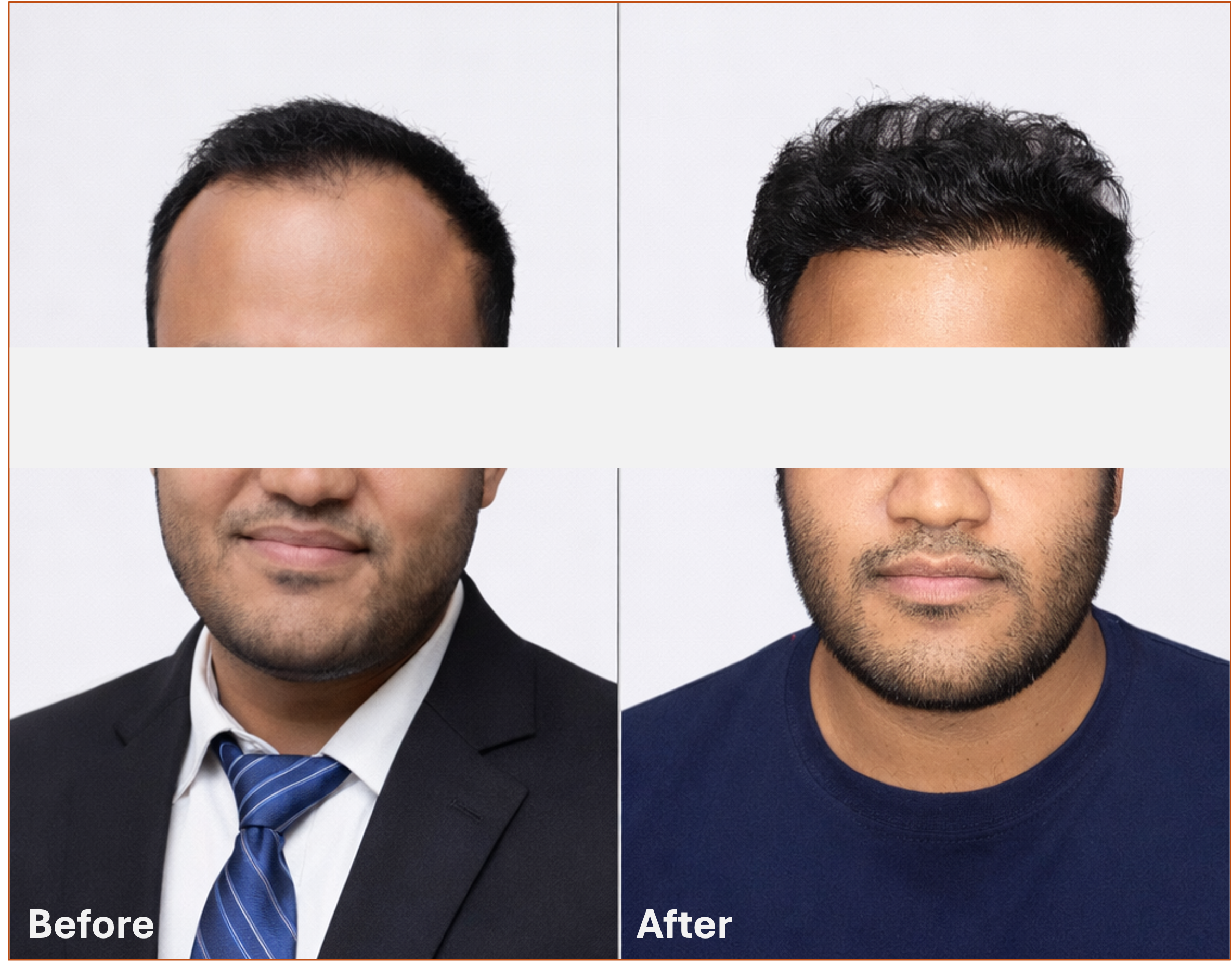
Hair Transplant at a Glance
| Treatment Detail | Information |
|---|---|
| Treatment | Hair Transplant / Hair Restoration |
| Recommended Technique | FUE (Follicular Unit Extraction) |
| Procedure Duration | Approximately 4–8 hours, depending on graft requirements |
| Anaesthesia | Local anaesthesia |
| Hospital Stay | Usually day care |
| Approximate Cost | ₹50,000–₹2,00,000+ (subject to confirmation and individual assessment) |
| Initial Recovery | Approximately 7–10 days |
| Return to Routine Activities | Usually within a few days, as advised by the surgeon |
| Initial Hair Growth | Usually begins around 3–4 months |
| Visible Improvement | Around 6 months onward |
| Final Results | Generally assessed around 9–12 months; further maturation may continue |
Note: Treatment duration, recovery and results vary between patients. The final treatment plan and cost depend on the number of grafts required, donor hair availability and individual clinical requirements.
Meet Dr. Vinay Jacob – Hair Transplant Surgeon in Mumbai
Dr. Vinay Jacob is a plastic surgeon associated with The Plastic Surgeons, Mumbai. He has over 10 years of experience performing hair transplant surgeries.
Hair restoration requires careful planning rather than simply transferring hair follicles from one area to another. Factors such as the pattern of hair loss, donor hair availability, scalp characteristics, hairline design and long-term hair loss progression need to be considered before surgery.
During a consultation, Dr. Vinay Jacob evaluates the patient's concerns and discusses suitable treatment options, the expected process, recovery requirements and realistic outcomes.
Why is consultation important before hair transplant surgery?
To understand the pattern and possible cause of hair loss.
To assess the availability and quality of donor hair.
To discuss an appropriate hairline design.
To determine whether FUE or another technique may be suitable.
To understand the limitations and expected results of surgery.
The treatment plan should be based on individual assessment rather than a standard number of grafts or a one-size-fits-all approach.
What Is Hair Transplant Surgery?
Hair transplant surgery is a hair restoration procedure in which hair follicles are taken from a donor area, usually the back or sides of the scalp, and placed into areas affected by hair thinning or baldness.
The transplanted follicles are selected and positioned to create a natural-looking distribution of hair. The placement, direction, angle and density of the grafts are important considerations when planning the procedure.
Hair transplantation is commonly considered for people experiencing pattern hair loss. It may also be discussed for certain cases of hair loss involving the hairline, crown or other areas of the scalp, depending on the cause and availability of suitable donor hair.
When Should You Consider a Hair Transplant?
Not every type of hair loss requires surgery. Some people may benefit from medical treatment or other non-surgical approaches, while others may be suitable candidates for hair transplantation.
You may consider a consultation if you notice:
A receding hairline that has become more noticeable over time.
Thinning hair around the crown or top of the scalp.
Permanent bald patches associated with pattern hair loss.
Reduced hair density despite trying appropriate hair loss treatments.
A desire to restore the appearance of a previously fuller hairline.
It is important to identify the underlying cause of hair loss before deciding on surgery. Sudden or unexplained hair loss should be medically evaluated rather than automatically treated as a hair transplant concern.
Who Is an Ideal Candidate for Hair Transplant Surgery?
Hair transplant surgery is not suitable for everyone. A person's age, hair loss pattern, donor hair availability and general health can influence whether the procedure is appropriate.
You may be considered for hair transplantation if:
You have stable or sufficiently established pattern hair loss.
You have adequate healthy donor hair.
Your scalp is suitable for the procedure.
You have realistic expectations about hair density and coverage.
You understand the recovery process and follow-up requirements.
You are medically suitable for surgery.
People with extensive baldness and limited donor hair may have restrictions on how much coverage can be achieved. Similarly, individuals experiencing active or unexplained hair loss may need further evaluation before considering surgery.
A consultation with a qualified surgeon can help establish whether hair transplantation is a reasonable option.
Types of Hair Transplant Techniques
Different techniques are used to extract and implant hair follicles. The appropriate method depends on the patient's hair loss pattern, donor area, treatment goals and the surgeon's assessment.
1. FUE Hair Transplant (Follicular Unit Extraction) -Follicular Unit Extraction, commonly known as FUE, involves extracting individual follicular units from the donor area using specialised instruments. These follicles are then prepared and implanted into the areas requiring hair restoration. FUE is our preferred hair restoration technique.
Key features of FUE:
Individual follicular units are extracted from the donor area.
The procedure avoids a long linear donor-area incision.
Small extraction sites are created during follicle harvesting.
The extracted follicles are placed according to the planned hairline and coverage requirements.
Recovery varies depending on the number of grafts and individual healing.
FUE may be considered for patients who have suitable donor hair and are looking for hair restoration without the linear scar associated with the traditional FUT approach.
2. FUT Hair Transplant (Follicular Unit Transplantation) -Follicular Unit Transplantation, or FUT, involves removing a strip of scalp tissue from the donor area. Individual follicular units are then separated from this tissue and prepared for transplantation.
Key features of FUT:
A strip of scalp tissue is removed from the donor area.
Follicular units are separated under magnification.
The grafts are implanted into the recipient area.
The donor area is closed with sutures.
A linear scar may remain at the donor site.
FUT may be discussed in selected cases, depending on donor characteristics and the patient's treatment requirements.
3. DHI Hair Transplant (Direct Hair Implantation) -Direct Hair Implantation, or DHI, is a term used for an implantation approach in which extracted follicles are placed using a specialised implanter device.
The suitability of this method depends on the patient's scalp condition, treatment plan and the surgeon's preferred technique. It should not be assumed to be appropriate for every patient.
FUE vs FUT vs DHI: Understanding the Differences
| Feature | FUE | FUT | DHI |
|---|---|---|---|
| Extraction method | Individual follicular units | Strip of scalp tissue | Usually individual follicular units |
| Donor-area closure | Small extraction sites | Sutures are used | Depends on extraction method |
| Linear donor scar | Generally avoided | May be present | Depends on extraction method |
| Implantation | Prepared grafts are placed into recipient sites | Prepared grafts are placed into recipient sites | Uses a specialised implantation device |
| Suitability | Depends on donor hair and treatment goals | Depends on donor hair and treatment goals | Depends on the individual treatment plan |
The most suitable approach should be selected after a clinical assessment. The availability of a particular technique at the clinic should be confirmed during consultation.
How Is Hair Transplant Surgery Performed?
Hair transplant surgery involves several stages. The exact process may vary according to the technique selected and the number of grafts required.
Step 1: Consultation and Scalp Assessment -The surgeon evaluates the pattern of hair loss, scalp condition, donor area and the patient's expectations. The possible cause of hair loss and suitability for surgery are also considered.
Step 2: Hairline Planning -The proposed hairline and recipient areas are planned according to facial proportions, existing hair growth and the patient's long-term hair restoration requirements.
Step 3: Preparation of the Donor Area -The donor area is prepared for follicle extraction. The selected technique determines how the follicles or donor tissue are collected.
Step 4: Hair Follicle Extraction -In FUE, individual follicular units are extracted from the donor area. The harvested follicles are handled carefully before implantation.
Step 5: Preparation and Implantation -The extracted grafts are prepared and placed into the recipient area. Their direction, angle and distribution are important for achieving a natural-looking result.
Step 6: Post-Procedure Instructions -After surgery, the patient receives instructions regarding scalp care, washing, activity restrictions, medication if prescribed and follow-up appointments.
Areas That Can Be Addressed With Hair Transplant Surgery
Hair transplantation may be considered for different areas of the scalp, depending on the cause of hair loss and the availability of donor follicles.
Frontal Hairline -Hair transplantation may help address a receding or uneven frontal hairline. Hairline planning is important because it influences how natural the overall result appears.
Crown Area -Some patients experience thinning or baldness around the crown. The extent of possible coverage depends on the size of the affected area and the available donor hair.
Mid-Scalp -Hair transplantation may be considered to improve hair coverage in the middle region of the scalp where thinning has developed.
Overall Hair Density -In selected cases, transplantation may help improve the appearance of density across more than one area. The achievable coverage depends on the number and quality of available grafts.
Hair Transplant Recovery: What to Expect
Recovery after hair transplant surgery is gradual. The healing process and visible hair growth timeline can differ from one patient to another.
First few days -Mild swelling, redness, tenderness or discomfort may occur around the treated areas. Small scabs may develop around the implanted follicles. Follow the surgeon's instructions for scalp care.
First two weeks -The scalp generally continues to heal. Scabs gradually settle, although the timing varies. Avoid rubbing, scratching or disturbing the treated area.
First one to three months -Some transplanted hair shafts may shed. This is commonly known as shock loss or post-transplant shedding. It does not necessarily mean that the transplanted follicles have failed.
Three to six months -New hair growth may begin to become noticeable. The amount and speed of visible growth vary between individuals.
Six to twelve months -Hair growth and coverage generally continue to develop. The appearance of the transplanted area may become more noticeable over this period.
Twelve to eighteen months -Some patients may continue to see changes in hair growth and maturation during this period, depending on the individual and the treatment area.
Your surgeon will advise you about the expected recovery and follow-up schedule for your procedure.
What Results Can You Expect After a Hair Transplant?
Hair transplant surgery aims to improve hair coverage in selected areas by using follicles from the donor region. However, results are not immediate.
Transplanted hair commonly goes through an initial shedding phase before new growth develops. The final appearance depends on factors such as:
The number and quality of transplanted grafts.
The availability of healthy donor hair.
The extent and pattern of existing hair loss.
The technique used.
Individual healing and hair growth characteristics.
Ongoing hair loss in non-transplanted areas.
A hair transplant does not stop the natural progression of hair loss in untreated areas. Some patients may need a long-term hair management plan to maintain an overall balanced appearance.
It is important to have realistic expectations about density, coverage and the time required to see results.
Is a Hair Transplant Permanent?
Transplanted follicles are generally taken from areas of the scalp that are more resistant to common pattern hair loss. Once established, these follicles can continue to grow hair over the long term.
However, this does not mean that every transplanted graft will grow permanently or that all existing hair will remain unchanged.
Non-transplanted hair may continue to thin over time. The long-term appearance also depends on donor hair characteristics, the extent of hair loss and individual factors.
Your surgeon can explain what may realistically be achieved and whether additional hair loss management may be needed.
Possible Risks and Complications of Hair Transplant Surgery
Like other surgical procedures, hair transplantation has potential risks and complications. Their likelihood and severity vary depending on the technique, the patient's health and individual healing.
Possible concerns include:
Temporary swelling or discomfort.
Redness and scabbing around the treated areas.
Bleeding or infection.
Temporary numbness or altered sensation.
Folliculitis or inflammation around hair follicles.
Shock loss affecting existing hair.
Uneven growth or differences in hair density.
Visible scarring in the donor or recipient area.
Results that may not match the patient's expectations.
Discuss these risks with your surgeon before deciding on surgery. Seek medical advice if you experience increasing pain, spreading redness, fever, discharge or other symptoms that concern you during recovery.
Hair Transplant Aftercare: Important Instructions
Following the recommended aftercare instructions is important for healing and protecting the transplanted area. Your surgeon may provide specific guidance regarding:
1. Scalp washing:Follow the recommended washing schedule and technique. Avoid unnecessary rubbing or pressure.
2. Sleeping position:Follow instructions on how to protect the scalp while sleeping during the initial recovery period.
3. Physical activity:Avoid strenuous exercise and activities that may disturb the treated area until your surgeon advises that it is safe.
4. Sun exposure:Protect the scalp from direct sun exposure as advised.
5. Medication:Take only the medication prescribed or recommended by your treating doctor.
6. Follow-up visits:Attend scheduled appointments so that healing and hair growth can be assessed.
Avoid following generic aftercare advice without checking whether it applies to your procedure.
Hair Transplant Cost in Mumbai
The cost of a hair transplant in Mumbai depends on the extent of hair loss, the number of grafts required and the complexity of the procedure.
At The Plastic Surgeons, the indicative hair transplant cost ranges from ₹50,000 to ₹2,00,000 or more, subject to confirmation after individual assessment.
The final estimate depends on several factors:
Number of grafts:The total number of grafts required to cover the affected area.
Extent of hair loss:The size of the bald or thinning area.
Donor hair availability:The quality and density of hair available for transplantation.
Procedure requirements:The surgical technique and complexity of the treatment.
Individual treatment plan:The patient's hair restoration goals and clinical requirements.
What Is Included in the Hair Transplant Cost?
Patients should confirm whether their treatment estimate includes:
Surgeon and surgical team fees.
Hair follicle extraction and implantation.
Anaesthesia and facility charges.
Prescribed post-operative medication.
Follow-up consultations.
Get Your Hair Transplant Cost Estimate
The final cost can be determined after assessing your scalp, donor hair availability and required graft count.
Consult Dr. Vinay Jacob at The Plastic Surgeons to understand the recommended treatment approach and the estimated cost for your hair restoration procedure.
Why Choose The Plastic Surgeons for Hair Transplant Consultation in Mumbai?
Choosing a hair transplant surgeon involves more than comparing treatment prices or the number of grafts offered. The surgeon's assessment, treatment planning and understanding of natural hair distribution are important considerations.
At The Plastic Surgeons, patients can consult Dr. Vinay Jacob to discuss their hair restoration concerns and understand the available surgical options.
Important considerations during treatment planning include:
Assessment of the donor and recipient areas.
Individualised hairline planning.
Discussion of suitable hair transplant techniques.
Realistic expectations about coverage and density.
Clear guidance about recovery and aftercare.
Follow-up to assess healing and hair growth.
The aim of consultation is to help patients understand whether hair transplantation is appropriate and what results may reasonably be expected in their individual case.
Book a Consultation With Dr. Vinay Jacob
If you are experiencing a receding hairline, thinning crown or pattern hair loss, a professional assessment can help you understand your treatment options.
Consult Dr. Vinay Jacob at The Plastic Surgeons, Mumbai, to discuss your hair loss concerns, donor hair availability and the suitability of hair transplant surgery.
Every patient's hair restoration requirements are different. A personalised consultation can help you make an informed decision based on your scalp condition, expectations and long-term hair restoration goals.
Contact The Plastic Surgeons to schedule your hair transplant consultation in Mumbai.
Frequently Asked Questions About Hair Transplant Surgery
1. Who is the right candidate for hair transplant surgery?
People with permanent pattern hair loss, adequate donor hair and realistic expectations may be suitable candidates. A scalp assessment is necessary to determine whether surgery is appropriate.
2. How do I choose a Hair Transplant Surgeon in Mumbai?
Consider the surgeon's qualifications, relevant surgical experience, understanding of hair restoration, treatment planning approach and ability to explain realistic outcomes. A consultation can help you assess whether the proposed treatment suits your needs.
3. Is hair transplant surgery permanent?
Transplanted follicles can continue to grow hair over the long term. However, non-transplanted hair may continue to thin, so ongoing hair loss management may be necessary.
4. Does a hair transplant look natural?
A natural-looking result depends on appropriate hairline design, graft placement, hair direction, angle and distribution. Individual results also depend on donor hair quality and the treatment plan.
5. Is hair transplant surgery painful?
The procedure is generally performed using local anaesthesia to reduce discomfort during surgery. Some soreness, tenderness or swelling may occur afterwards. Your surgeon can explain what to expect during recovery.
6. How long does it take to see hair transplant results?
Visible growth develops gradually. Initial shedding may occur during the first few months, followed by new growth. Results continue to develop over several months, and some patients may see further maturation up to 12–18 months.
7. Can completely bald people undergo hair transplant surgery?
It depends on the availability and quality of donor hair. People with extensive baldness and limited donor hair may have restrictions on the coverage that can be achieved. A clinical assessment is needed.
8. What is the difference between FUE and FUT hair transplant?
FUE involves extracting individual follicular units from the donor area, while FUT involves removing a strip of scalp tissue from which follicular units are separated. Both techniques have different considerations regarding extraction, scarring and recovery.
9. Can a hair transplant treat a receding hairline?
Hair transplantation may help restore the appearance of a receding hairline in suitable candidates. The surgeon needs to assess the pattern of hair loss, donor hair availability and appropriate hairline design.
10. Can hair loss continue after a hair transplant?
Yes. Transplanted follicles may continue to grow hair, but existing non-transplanted hair can continue to thin. A long-term hair restoration plan may be recommended.
11. How many grafts are required for a hair transplant?
The number of grafts depends on the size of the area being treated, the degree of hair loss, donor hair availability and the desired coverage. The exact requirement can only be estimated after an individual assessment.
12. What precautions should I take after hair transplant surgery?
Follow your surgeon's instructions regarding scalp washing, sleeping, physical activity, medication and sun exposure. Avoid rubbing or scratching the treated area and attend scheduled follow-up appointments.
 Call
 WhatsApp